Esta es la primera entrada de mi nuevo blog. Acabo de empezar a escribir este nuevo blog. ¡Mantente al día para leer más entradas! Suscríbete a continuación para recibir notificaciones cuando publique nuevo contenido.
The purpose
of this experiment was to investigate the behaviours of three different
materials, two in the elastic state and one in the plastic region. This
experiment was used to highlight Hook’s law which states that; Within certain
limits, the force required to stretch an elastic object such as a metal spring
is directly proportional to the extension of the spring. This is known as
Hooke’s law and commonly written:
F=−kx(1)
Where F =
the Force
X = the
Displacement of the material
K = spring
constant
Method
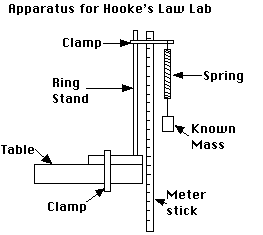
Figure 1
Assemble the apparatus as shown in the diagram at right. Be sure to clamp the ring stand to the lab table, or weight it with several books.
Construct a data table. You will need to record the mass that you hang from the spring and the position of the end of the spring before and after the mass is added. From this, you will calculate the force applied to the spring and the resulting stretch of the spring. You should allow for at least 8-10 trials
For each trial, record the mass, the starting position of the spring (before hanging the mass) and the ending position of the spring (while it is being stretched).
Repeat the process for a rubber band. (2)
Results
Figure 2 a = 1.5515 b= 1.4182
Figure 3
The graph in figure 2 explains the
relationship between the force applied to the material and the displacement of
the material, it shows that as the force increases so does the displacement of
the material which proves that there is a linear relationship between the two
variables.
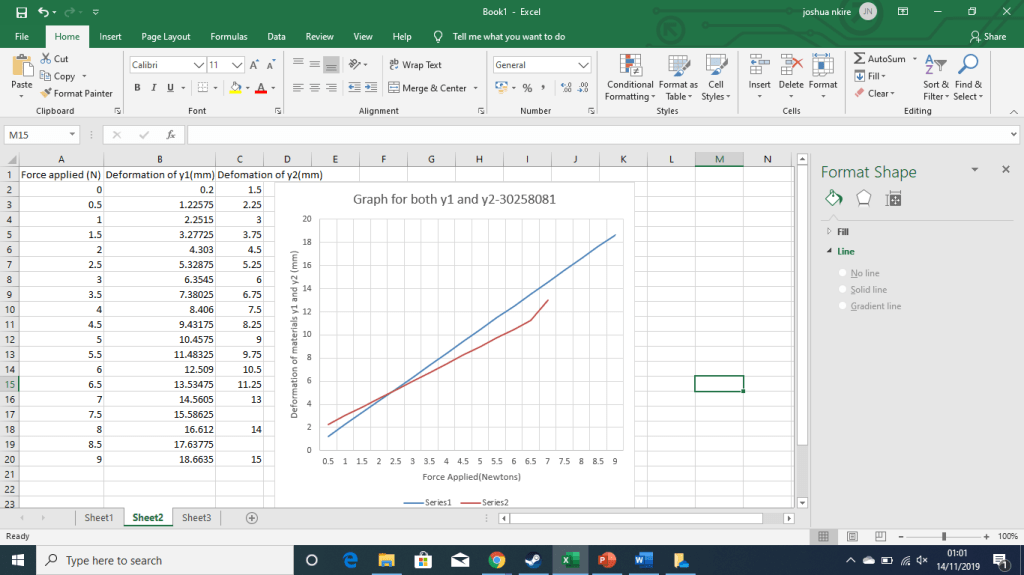
The graph in
figure 3 shows the relationship between the two materials that are in the
elastic region, this graph shows that in both material’s the relationship
between the force and the material is linear which supports the theory of hooks
law. From the graph you can see that the line generated from the deformation of
y2 is more inclined compared to the line of y1 this indicate that the material of
y2 was more difficult to stretch as it required more force. The graph also
shows the intersection of both graphs which from the estimate was at the points
(2.5,5.2). Calculating the points of intersection theoretically through the use
of simultaneous equations gave me the points (2.4,5.2) which compared to the
estimated value was 96.2% accurate as per the error percentage calculations.
Solving simultaneously
Y2= 2.0515x+0.2
Y1= 1.5515x+1.4182
2.0515x+0.2=1.5515x+1.4182
0.5x=1.2182
X=2.4
2.0515(2.4) +0.2=y
Y = 5.2
Figure 4
The graph in figure 4 shows the relationship between the
force and the Material, in this graph the relationship between the two
variables is not a linear one, the relationship is an exponential/polynomial one.
The relationship is like this because the material z has now gone past the
elastic region and is in the plastic region which means that it can not return
to its normal shape due to the amount of force that was applied to it. For this
reason, we do not see a linear graph instead we see an exponential/polynomial
graph as the material has reached permanent deformation and will continue like
that until the material breaks.
Conclusion
The aim of
this experiment was to investigate the behaviours of three materials and how it
relates to hooks law. Hook’s law states that the force required to stretch an
elastic object such as a metal spring is directly proportional to the extension
of the spring. The graph in figures 2 and 3 help to support this theory as the
relationship in both graphs were linear. The graph in figure 4 however does not
support this however this is because the material had reached the plastic
region due to excess force being applied causing the material to become permanently
deformed.
In figure 2 you can see that at two points the results show
anomalies as it does nt follow the linear relationship as the other points do,
this could be due to equipment errors, for example; the material could have
been deformed this could leave errors in the results. In order to make the
results more accurate, the experiment should have been completed at least 3
times with the same material.
Esto es una entrada de muestra, originalmente publicada como parte de Blogging University. Regístrate en uno de nuestros diez programas y empieza tu blog con buen pie.
Hoy vas a publicar una entrada. No te preocupes por el aspecto de tu blog. Tampoco te preocupes si todavía no le has puesto un nombre o si todo esto te agobia un poco. Tan solo haz clic en el botón «Nueva entrada» y explícanos por qué estás aquí.
¿Por qué es necesario?
Porque proporciona contexto a los nuevos lectores. ¿A qué te dedicas? ¿Por qué deberían leer tu blog?
Porque te ayudará a concentrarte en tus propias ideas sobre tu blog y en lo que quieres hacer con él.
La entrada puede ser corta o larga, una introducción de tu vida o una declaración de los objetivos del blog, un manifiesto de cara al futuro o una breve descripción del tipo de cosas que pretendes publicar.
Te ofrecemos algunos consejos útiles para ayudarte a empezar:
¿Por qué publicas tus entradas en lugar de escribir en un diario personal?
¿Sobre qué temas crees que escribirás?
¿Con quién te gustaría conectar a través de tu blog?
Si tu blog resulta ser un éxito a lo largo del próximo año, ¿qué objetivo te gustaría lograr?
No tienes por qué atarte a las decisiones que tomes ahora. Lo bueno de los blogs es que evolucionan constantemente a medida que aprendemos nuevas cosas, crecemos e interactuamos los unos con los otros. Pero está bien saber dónde y por qué empezaste, y plasmar tus objetivos puede darte más ideas para las entradas que quieres publicar.
¿No sabes por dónde empezar? Tan solo escribe lo primero que se te ocurra. Anne Lamott, autora de un libro sobre cómo escribir que nos encanta, afirma que debemos permitirnos escribir un «primer borrador de mierda». Anne está en lo cierto: tan solo tienes que empezar a escribir, y ya te encargarás de editarlo más tarde.
Cuando todo esté listo para publicarse, asigna entre tres y cinco etiquetas a la entrada que describan el centro de atención de tu blog: escritura, fotografía, ficción, educación, comida, coches, películas, deportes… ¡Lo que sea! Estas etiquetas ayudarán a los usuarios interesados en tus temas a encontrarte en el Lector. Una de las etiquetas debe ser «zerotohero», para que los nuevos blogueros también puedan encontrarte.


 Título del sitio web